
13/12/2018 AGM + Dress the Lady
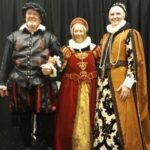
The Annual General meeting was attended by 67 members. Secretary David Hickman will detail the meeting in full in due course.
At the close of the business section of the meeting refreshments were taken then President Michael Blamire-Brown announced that entertainment would follow. It was intriguingly entitled “Dress the Lady”. The lady in question was Outings Organiser for the society Gill Turner who gamely agreed to be dressed in Elizabethan costume. The first item was a chemise or shift made of linen; very useful as it was highly absorbent. It was explained that a lady would change her chemise twice a day. This was followed by a red underskirt. Red in colour because this was considered to promote good health. A corset in the shape of an inverted cone followed. It was shocking to learn that children as young as 2 years wore corsets. A farthingale was next to give the outfit shape followed by a dress with a “v” shape set into it to showcase the patterned skirt underneath. It was clear from Gill’s demeanour that costume was both weighty and cumbersome. Two types of ruff were demonstrated and the whole outfit was topped off by a headdress. Gill looked splendid! A description followed of the clothing worn by gentlemen of the era as sported by one of the dressers. This included doublet, puffed out leggings, lederhosen and a codpiece which attracted some considerable interest. It was a very entertaining evening.
President Michael Blamire-Brown wished everyone a Happy Christmas and a prosperous New Year and announced that the first meeting of 2019 will be take place on 17th January when Peter Bates will deliver ‘A History of English Graveyards.’
15/11/2018 Michael Glasson
The November meeting of Stourbridge Historical Society took place on Thursday 15th November 2018. Our Vice President Trevor Sidaway welcomed 64 members, 7 visitors and Michael Glasson, a speaker who was new to the Society. He was the Curator of the Leather Museum in Walsall for many years. Michael’s subject talk was entitled ‘Walsall: Town of a Hundred Trades.’
Michael began by explaining that Walsall’s High Street had recently been designated the second worst in Britain and explaining that he hoped the audience would see his home town in a more favourable light by the end of his talk. Walsall’s industrial heritage goes back 4000 years, it had a 30 feet coal seam underground and access to limestone clay and iron ore, so important for industry. There was a flourishing metal industry in the middle ages.
In the 16th, 17th, and 18th centuries Walsall became a very important centre for the production of buckles. Also, by the 19th century it was the leading centre for stirrups and horsebits. Matthew Honey and Co. made stirrups for many countries including South America and the USA and also specialised in gaucho spears. The 19th century also saw the arrival of blast furnaces and the development of process for the malleable casting of iron which increased the range of items produced and assisted production. Walsall became renowned for electroplating and galvanising. Heavy industry was in evidence all along the canal.
Leather making is synonymous with Walsall and its most celebrated industry. In 1830 a lorimer named Thomas Meaton began making saddles to go with metal stirrups etc., which led to Walsall producing saddles for a global market and by 1890 Walsall was globally dominant in this field. Walsall had many tanneries as a result of the significant demand for leather. The coming of the car caused a decline in the demand for saddlery. The industry moved in part toward satchels, bags and purses and high-end products. A bag carried by Grace Kelly in the film Rear Window was made in Walsall. To this day leather bags made in Walsall are highly sort after. Michael explained that Japanese visitors to the Leather Museum shop quickly clear the shelves of high-quality bags produced by Whitehouse Cox in Walsall. The Lorna of London bags used by Queen Elizabeth II are made in Walsall.
Another industry which developed as stirrup making declined was the production of stainless steel. Wiggins of Bloxwich made the move from stirrups to stainless steel and they began making tea pots and cutlery. Robert Welch became their in-house designer for the very successful and world class Old Hall range. Michael spoke about many other industries which developed or diversified and became important for the Walsall economy. The Walsall Lithographic Company produced catalogues for saddlery and seats. In 1964 the Walsall Security Company produced the world’s first self-adhesive stamp. John Hawley and Company produced ropes, twines and cords. The discs for the Selfridges Department store in Birmingham were produced in Walsall. Michael explained that despite its decline as a manufacturing area Walsall still holds Four Royal Warrants. He summed up his talk by saying that he felt Walsall should be applauded for its excellence, innovation, adaptability and receptiveness.
Trevor thanked Michael for opening everyone’s eyes to Walsall’s diversity and announced that the next meeting will be the society’s AGM which will take place on Thurdsay December 13th. 2018.
18/10/2018 Dr. Gillian White
The October meeting of the Stourbridge Historical Society took place on Thursday 18th October at 7.30 p.m. Our President Michael Blamire-Brown welcomed 62 members, 5 visitors and a very popular and familiar speaker, Dr Gillian White. She delivered a talk entitled ‘Queen Victoria. A life in Portraits’. Gillian explained that she would give an insight into the life of Victoria through paintings. Some would be familiar but others less so.
The reputation of monarchy was poor when Victoria was born at 4.15 p.pm on 24th May 1819. The three Hanoverian Georges that preceded her were not highly thought of. Her father died before she was a year old. Victoria’s mother the Duchess of Kent raised her, assisted by Sir John Conroy, to give a perception of pliability, purity and suitability in an attempt to refashion the monarchy. Many carefully constructed portraits commissioned by the Duchess of Kent were to play a vital part in that endeavour.
A charming portrait by Stephen Poyntz Denning a portrait painter and gallery owner showed Victoria aged 4 years old still dressed in mourning for her father. Its construction means that the viewer tends to look up at her thus creating an air of superiority in the young child. Another by her drawing master Richard Westall painted in 1830 when she was 11 years old shows Victoria and her adoring pet terrier. The adoration on the face of the dog gives her an air of worthiness.
Victoria became Queen on 20th June 1838. The new queen commissioned Sir George Hayter to paint her as she was at her coronation. In that year Charles Robert Leslie painted. Queen Victoria receiving the Sacrament at her Coronation. Both paintings capture the majesty of the events. In 1887-1830 Sir Edward. Lanseer painted Queen Victoria in 1837 -1839 on horseback; a portrait that bears a striking resemblance to Van Dyck’s famous portrait of Charles 1. There had long been a vogue for painting monarchs on horseback for the sense of authority and majesty that it conveyed. Another such portrait was Sir Francis Grant’s (1839-1804) painting ‘Queen Victoria Riding Out’.
The next step taken through portrait to create a precise image of Queen Victoria was to convey a successful marriage and perfect family. Sir George Hayter produced a painting of Victoria’s marriage to Albert in 1840. She wore a white wedding dress and had a garland of orange blossom in her hair rather than the more usual tiara. The floral headdress was an indicator of chastity. Victoria’s intense love for Prince Albert is encapsulated in a painting by Franz Xavier Winterhalter entitled The Linked Hands of Queen Victoria and Prince Albert. Winterhalter also painted a very striking portrait of Victoria which she gave to Prince Albert as a birthday present. It is a very personal portrait; she is shown informally with her hair loose.
The arrival of children allowed Victoria and Albert to promote family values through portraits. Edward Lansdseer produced Windsor Castle in Modern Times which showed their first born playing in the corner of the canvas. In 1846 Winterhalter painted The Royal Family. This was more formal than Landseer’s painting and featured their enlarged family. It depicted Victoria as both sovereign and mother This was a painting was seen by 100,000 people and was hated by the critics partly because it was painted by a foreigner. Another Winterhalter portrait featured Victoria at Osborne House with Prince Arthur. The mood of the painting was Italian and has a sense of the Madonna and child.
20/09/2018 Anthony Collis
The September meeting of the Stourbridge Historical Society took place on Thursday 20th at 7.30p.m. Our president Michael Blamire-Brown welcomed a new speaker, Anthony Collis, who gave a talk entitled Victorians Batting for, and against Stourbridge to 66 members and 7 visitors.
Anthony explained that cricket gradually developed and gained in popularity in the Victorian era and that Hagley not Stourbridge had the first cricket club in the area. The date of the founding of Stourbridge Cricket Club is not known for certain but it has become accepted from the information available that it was 1842. The first detailed record of a match was in 1847. The All England XI played Stourbridge. Amongst the team were Frances Rufford a brickmaker who lived locally at Prescot House and was MP for the city of Worcester. Also named was Reuben Roby the first Stourbridge player to play for England. Anthony showed an interesting photograph of the All England XI wearing top hats.
The Earl of Stamford and Warrington was an important name in the Victorian era and the history of Stourbridge cricket. He had inherited Enville Hall and Dunham Massey in Cheshire. He was also Lord of Amblecote and had an astonishing income of £90,000 per annum. It was thanks to his generosity that Stourbridge Cricket Club moved to their new ground opposite Amblecote Church in 1857. The Earl established a very fine wicket at Enville Hall which is still used by Enville Cricket Club.
In 1859 Stourbridge played Dudley. A Stourbridge player of note was Charles George Lyttelton. The Lyttelton name crops up again when the family XI turned out against Bromsgrove school. Their team comprised eleven sons and two uncles. A photograph of 1890 showed H Collis a Stourbridge team member who was responsible for suggesting the name of the War Memorial Ground for the Stourbridge Cricket Club by which it has been known since the 1920s.
There were other players from the early days of the Stourbridge club who were men of note in the Midlands. W G Webb son of the Edward Webb the founder of Webb’s seeds, now known as Webbs of Wychbold, was a keen sportsman who entered public life as MP for Kingswinford. Charles Holcroft became a Baronet and was a generous benefactor to Birmingham University. W J Turney the owner of the tannery works was an outstanding personality in the life of Stourbridge. Others were Hickman whose company made bricks, Cochrane 0f Cochrane’s Iron Works in Holly Hall, Dudley and Firmstone whose family were also iron masters.
Anthony concluded by recalling the many street names in our area that were named after men who had played for Stourbridge Cricket Club throughout the Victorian period. Cobham Road, Hickman Road, Evers Street, Foley Road, Holcroft Road, Lyttelton Road, Palfrey Road, Collis Street, Firmstone Street and Stamford Road are but a few.
17/05/2018 Max Keen
The vice president, Trevor Sidaway, welcomed 82 members and 27 visitors to a talk by Max Keen entitled King John. The worst or most useful King?
As his custom Max arrived in full costume explaining that the sword he was carrying was an exact copy of one depicted in a painting of King John by William Marshall which is believed to be a very good likeness of the King. John reigned from 1199 to 1216, was the youngest of five sons of King Henry II of England and Eleanor of Aquitaine and is buried in Worcester Cathedral. It is thought he died from either dysentery or poisoning. He was about 5’ 5’’ which would have been average height for the time and he had a shock of Plantagenet red hair. He was the first English King since 1066 to speak English and he was very well read; he travelled with his own library. We also learned that he spent a significant amount of time hunting locally at Stourton Court.
King John lived in the shadow of his brother Richard who had earned a reputation for bravery. John by contrast has mostly gone down in history for his cruelty. He is of course depicted as the ‘baddie’ in the Tales of Robin Hood. He had fits of rage, used blinding and castration as methods of torture and killed his own nobles in both England and France by starving them; a method that was even commented on at the time and was abhorred by Richard. He supposedly murdered Arthur his young nephew. He allowed a mother and child to starve to death in Windsor castle and abandoned his army in France and fled back to England; the height of cowardice.
In war in northern France in in 1202 but the lack of funds and his treatment of Norman Breton and Anjou nobles resulted in the collapse of his empire in northern France. He spent the rest of his reign trying to reclaim his lost land. Nobles had their castles taken away, he introduced excessive taxation, sold charters for new towns and even tried to appoint his own Archbishop of Canterbury.
King John’s greatest legacy is considered to be the Magna Carta signed at Runneymede 15th June 1215 in which the rights of the individual were protected from the power of the Monarch. It was drawn up by the Archbishop to make peace between the King and his rebel barons. It determined that no one should be above the law not even the King or Queen. It set down the rules for the Church, business and justice. A few months later King John sought permission from Pope Innocent III to have the Magna Carta annulled. It was however reissued by his son Henry III in a diluted form in 1216 and continued to impact on history from there on.
Max had begun by asking whether King John was the worst or most useful King and concluded by declaring that in his opinion he was in fact an idiot!
Trevor thanked Max for another entertaining talk and announced that the Society has two trips during the summer and that the next meeting is to be held on Thursday 20th September when Anthony Collis will talk on ‘’Victorians Batting for Stourbridge’’.
15/03/2018 Ned Williams
Michael Blamire-Brown, President of Stourbridge Historical Society welcomed 83 members and 11 visitors to a talk by Ned Williams entitled Palaces for the People: the story of Prefabs.
Ned’s illustrated talk was born of a lifelong interest in houses in general and prefabs in particular as they were part of his childhood. He showed the audience some photos taken from the Ideal Home in 1926 and 1962 houses in kit form which set the scene for the rest of the talk. He explained that prefabs came in many shapes and sizes and were made of a variety of materials.
Manufacturers of corrugated iron buildings exported their kits across other parts of the world especially the colonies, Australia and New Zealand. The colonial style with a veranda was very popular. The versatility of the buildings was a positive feature. They were customised according to their destination. Those produced for the Queensland market were built on stilts because of the risk of flooding.
War had a significant impact on housing stock and prefabs were considered as a means of solving the problem. Even before World War II in the 1930’s there was a serious housing crisis which was further exacerbated by the bombing. By the second half of the war squatting was becoming common. A photo of people living in a POW camp vacated by the Italians evidenced this. In 1944 Winston Churchill announced The Temporary Housing (the TPC) which he saw as a temporary of five years duration. Prefabricated buildings were chosen as a means to solve the housing problem. Many firms producing goods for the war effort foresaw that they would need to diversify post-war. Wolverhampton company Boulton and Paul was one such firm who moved from manufacturing aircraft wings to producing prefabs. Many variations were produced by different companies; aluminium, concrete block, steel framed and corrugated iron for example.
Distribution of prefabs across the country was uneven; some areas had significant numbers but others relatively few. The Ministry of Housing made decisions on their location. Their decisions were based on how ready areas were to accept prefabs with regard to roads and services etc. Ned explained that Folkestone had a large number on what had been an Army camp. By 1948 the TPC had ceased and 156,667 prefabs had been built; well short of the quarter of a million which had been the stated aim in 1944. Several types were built. The Arcon Mark V made with cement coated asbestos panels, an example of which can be seen in the Avoncroft Museum. The Uni Seco which had a rectangular porch. The Tarran which came in either one or two storeys. The Orlit made of concrete blocks and which featured heavily in the Black Country and the Scotswood which had self-supporting walls with windows installed before delivery. After 1948 Local Authorities subsequently built prefabs. On the Buffery Road Estate in Dudley there are examples made of iron and in Fordhouses in Wolverhampton prefabs constructed from stuccoed concrete blocks.
In the 1980’s Margaret Thatcher introduced the Right to Buy which led to prefabs being sold to tenants. Many were then customised. They were re windowed, re roofed, and painted different colours and consequently became more difficult to spot. Problems arose when local authorities wanted to demolish prefabs as many estates had a mix of rented and owned examples. Ned pointed out that in the 21 century we are still experimenting with prefab and that the mobile home could be considered to be the modern prefab.
The President thanked Ned for his fascinating and entertaining evening and announced that the next meeting will be held on Thursday 17th May at 7.30 when Max Keen will deliver his talk King John: The Worst or Most Useful King?
15/02/2018 Roger Butler
The President Michael Blamire-Brown welcomed 79 members 19 visitors and 7 new members to a presentation by Roger Butler entitled A Circumnavigation of the West Midlands: A Canal Journey in 1971.
Roger’s illustrated talk was based on two of twenty inherited photograph albums. They contained beautifully drawn maps, ‘photos and captions recording a journey circumnavigating the West Midlands Canals. It was undertaken between July 2 and July 16 1971 by 4 people in a 6-berth cruiser named Leif Ericson which travelled at 4 miles per hour. By recording their travels recording they intended ‘to show the cut in its infinite variety’.
Roger showed photographs of many locks; Bratch, Greensforge, Holt, and Hyde at Kinver to name but a few and he explained the variation in the skill required to navigate them. Fascinating lock keeper’s cottages were encountered along the way; some so small that they were little more than sheds. 0n the stretch of the journey along the Shropshire Union Canal the travellers encountered several high bridges in beautiful settings.
From a social history perspective, the talk was a gem. Clothing, hairstyles, cars, shops, signage, the food that the travellers cooked and consumed and the complete lack of life jackets all recalled a bygone era. A sign outside one pub on their journey offered ‘roast lamb and all the trimmings for 50p’. The ‘photos taken, as they passed through Birmingham were of special interest. They recorded the construction of Spaghetti Junction and the significant number of buildings which were being erected alongside and over the canal at that time.
It was noticeable that throughout the journey the canal was mostly populated by old fashioned cruisers made of fibreglass or timber; there were very few narrowboats. Roger explained that many canal cruising clubs came into being in the 1970’s and that diesel pumps were available at the side of the canal to accommodate this.
The captions that accompanied the ‘photos were often humorous and frequently displayed the writer’s disdain for the lack of efficacy of the British Water Ways Board. This was apparent in the Birmingham leg of the journey where the shortfall of environmental control was clearly evidenced by the detritus in the water and the parlous state of the canal towpaths. As Roger said boating through Birmingham in the 1970’s was pioneering stuff!
The President thanked Roger for his enjoyable and informative talk.
The next meeting is in the Wollaston Room at Stourbridge Town Hall on Thursday 15th March when Ned Williams will speak on ‘Prefabs; Palaces for the People’.
18/01/2018 Julian Hunt
The new President of Stourbridge Historical Society, Michael Blamire–Brown, welcomed 71 members, 10 new members and 11 visitors to a presentation by Julian Hunt entitled Worcestershire Turnpike Roads.
Julian explained that turnpike roads came into being in the 17th century and became more common in the 18th. Their purpose was to collect tolls in order to maintain roads which were falling into disrepair. Turnpike Trusts were set up by individual Acts of Parliament and were in place for 21 years after which they had to be renewed. Local clergy, gentlemen and merchants were nominated as trustees and they in turn appointed a clerk, a treasurer and surveyor to administer and maintain the roads. Local men Thomas Brettell a solicitor, Thomas Waldron the glassmaker and ironmaster, John Hodgetts, Francis Homfrey the glass manufacturer and William Foley were such trustees named in one Act.
The trusts erected the turnpike gates but it was the Act that set the rates to be collected from the various vehicles and animals that passed through the turnpike. Much of the wording of the Acts was noticeably common to every Act.
Julian showed several photos of turnpike gates and houses; and early photograph of a turnpike gate at Fairfield and a toll house at Hayley Green and one at Penn in Wolverhampton. He explained that there is a surviving turnpike toll house at the top of Grange Hill in Halesowen. A turnpike toll house on Bromley Lane in Kingswinford was in existence until the 1960’s.
Turnpike roads realised significant sums of money. A toll house at Brettell Lane collected an astounding £378 in 1791. The money realised from the tolls was frequently well spent. An order book of 1821 to 1830 for Stourbridge Roads shows that money collected from tolls was used to improve part of the town by raising and lowering certain parts of High Street, paving the town and taking up and repairing the Ryemarket and Coventry Street.
After questions the President thanked Julian for his interesting talk.
Michael closed the meeting by announcing that the next meeting will be on Thursday 19th February when Roger Butler will talk on A Circumnavigation of the West Midlands: A Canal Journey.